Introduction
The history of medieval Leyny in south County Sligo is usually dominated by the story of the O’Haras, the great Gaelic ruling dynasty who controlled the territory for centuries before the Cromwellian conquest. Yet beneath the authority of the O’Hara chiefs existed a wider network of hereditary families who played important political, ecclesiastical and intellectual roles within Gaelic society. Among the most distinguished of these were the Ó hUiginn, later anglicised as Higgins.
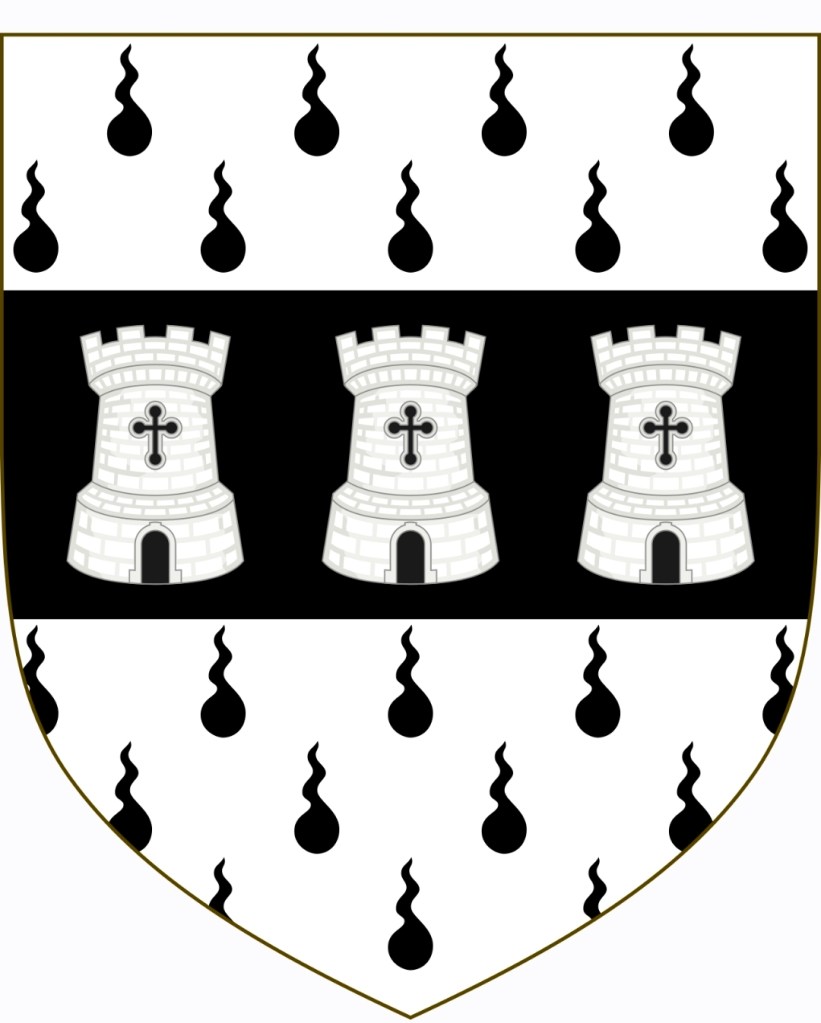
Figure 1. Traditional crest associated with the Higgins (Ó hUiginn) family.
The hUiginn family achieved considerable renown throughout medieval Connacht and Ireland as poets, historians and learned men attached to several of the great Gaelic lordships of the west. Their literary tradition produced some of the most respected bardic poets in Ireland, including Donnell Ó hUiginn, described in the Annals of the Four Masters as “chief preceptor of the schools of Ireland in poetry,” and the celebrated Tadhg Dall Ó hUiginn, whose poetry and violent death entered Irish historical tradition.
Although the family is primarily remembered for its literary achievements, surviving historical evidence suggests that the Higginses were also an important landed family within south Sligo. In his nineteenthcentury History of Sligo, Terence O’Rorke recorded that the principal headquarters of the family were located at Dooghorne in the parish of Achonry. Historical placename evidence now identifies Dooghorne with the modern townland of Chaffpool in the parish of Achonry–Mullinabreena, while the continued local use of the placename “Dohern Hill” appears to preserve a memory of this older Gaelic landscape.
By 1641 members of the Higgins family held a substantial concentration of lands across the Achonry–Mullinabreena district, including Chaffpool, Mullinabreena South, Streamstown, Carniara, Ballinvally, Lavagh, Mullaghanarry, Carrowmurray, Clooncunny, Rinbaun and Magheranore. Additional Higgins possessions are also recorded in neighbouring districts such as Montiagh in Curry parish, as well as lands in Kilmacteige and Cloonacool.
Taken together, the annalistic references, placename evidence and seventeenth-century land records suggest that the Ó hUiginn family were far more than itinerant court poets attached to Gaelic chiefs. Instead, they appear to have formed an influential learned Gaelic lineage deeply rooted in the landscape of Achonry–Mullinabreena, where literary prestige, territorial influence and local memory survived together for centuries.
The Learned Tradition of the Ó hUiginn Family
Medieval Gaelic society was sustained not only by ruling dynasties and military power, but also by a sophisticated hereditary learned tradition. Across Ireland, important Gaelic lordships supported professional families who specialised in poetry, history, genealogy, law, medicine and ecclesiastical scholarship. These learned dynasties preserved genealogies, legitimised ruling families through praise poetry and maintained intellectual traditions that often passed from generation to generation within the same kin-groups.
Within the territory of Leyny in south County Sligo, the O’Hara dynasty dominated the political landscape throughout much of the medieval period. By the later Middle Ages the family had divided into two principal branches, commonly remembered as the O’Hara Buidhe and O’Hara Riabhach. Beneath these ruling dynasties existed a wider network of subordinate hereditary families including military lineages, ecclesiastical groups and learned families who formed an essential part of Gaelic political society.
Among the most important of these were the Ó hUiginn, later anglicised as Higgins. The family belonged to the wider hereditary bardic tradition of medieval Ireland and, like the Ó Dálaighs and Mac an Bhairds, produced poets and scholars across several centuries. Their work formed part of a highly structured literary culture in which professional poets occupied recognised status within aristocratic society and enjoyed patronage from many of the leading Gaelic dynasties of Connacht, including the O’Haras, O’Conor Don, MacDermotts and MacDonaghs.
Dooghorne and Chaffpool
Historical placename evidence identifies the former district of Dooghorne with the modern townland of Chaffpool in the parish of Achonry–Mullinabreena. This identification provides an important geographical anchor for the history of the Ó hUiginn family within south Sligo and helps locate the family firmly within the landscape of the modern parish.
Writing in the nineteenth century, Terence O’Rorke stated that the “head-quarters” of the O’Higgins family were situated at Dooghorne in Achonry parish. For many years the precise location of Dooghorne remained uncertain. However, evidence preserved by the Placenames Database of Ireland (Logainm.ie) records a sequence of historical forms including Doughorne, Dowgherne, Dowchorne and Doogharne from the sixteenth and seventeenth centuries, all associated with the townland now known as Chaffpool.
The identification is strengthened by seventeenth-century cartographic evidence. William Petty’s Hiberniae Delineatio (1685) marks a district named “Doughorne” within the Achonry landscape corresponding closely with the location of modern Chaffpool. Local oral tradition also appears to preserve the older name, as the hill overlooking Chaffpool continues to be known locally as “Dohern Hill,” preserving a linguistic survival of the earlier medieval placename into the present day.
The historical landscape of Chaffpool also preserves traces of an earlier Gaelic past beneath the later estate landscape. O’Rorke recorded that Chaffpool was formerly known as “Loughanacaha” and preserved local traditions concerning an earlier Irish chief associated with the district. He also described the remains of a moated site or “grange” near Chaffpool House, which local tradition regarded as resembling the remains of a crannog or lake dwelling. Although the precise date and character of the site remain uncertain, such traditions may preserve distant memories of an earlier Gaelic settlement landscape within historical Dooghorne.
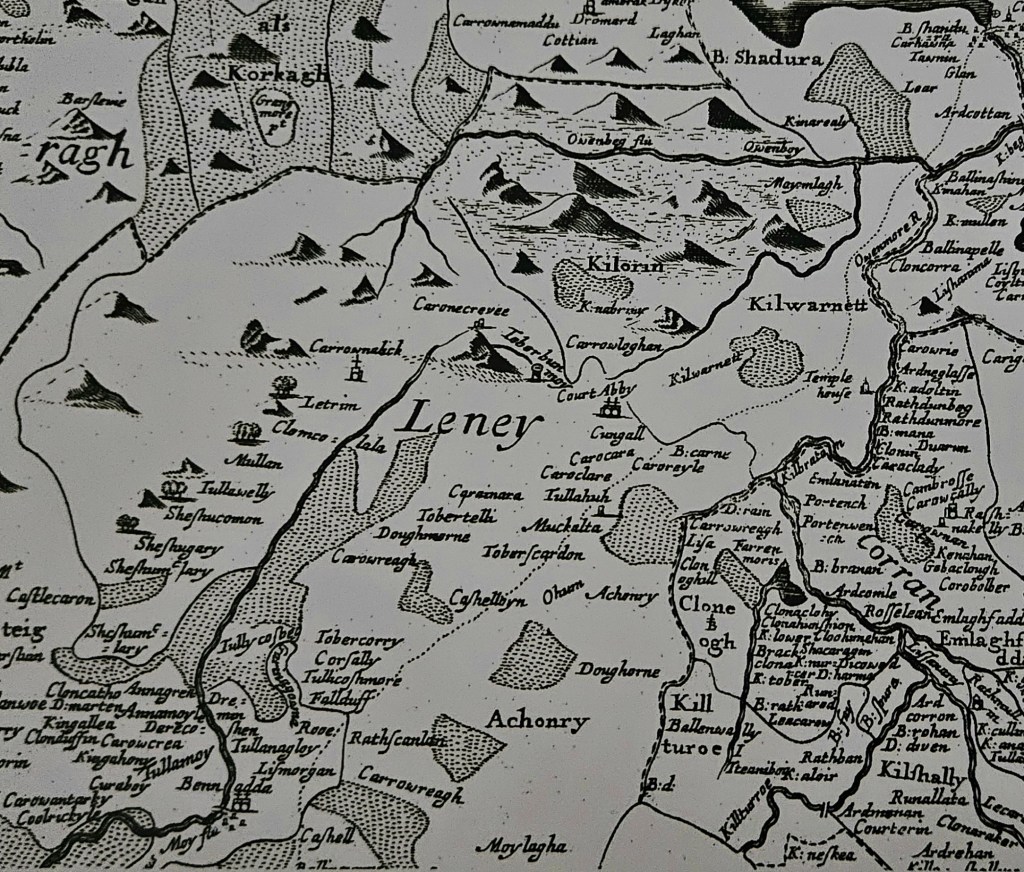
Figure 2. Extract from William Petty’s Hiberniae Delineatio (1685) showing the barony of Leyny and the district of “Doughorne” (Dooghorne), the historical name of modern Chaffpool. The map provides important cartographic evidence for locating the traditional headquarters of the Ó hUiginn family within the Achonry–Mullinabreena landscape.
During the eighteenth and nineteenth centuries the district became absorbed into the estate system that followed the collapse of the Gaelic order. Chaffpool House later emerged as the centre of the Somers and Armstrong estates, gradually replacing the older Gaelic associations of the area. Yet despite these transformations, the survival of placename evidence and local oral tradition preserves an important connection between modern Chaffpool and one of the principal learned Gaelic families of medieval Connacht.
The Dooghorne Inheritance
The connection between the Ó hUiginn family and the Achonry landscape was not merely literary but also territorial. According to historical sources, the celebrated bardic poet Tadhg Dall Ó hUiginn possessed lands at Dooghorne in Achonry and at Coolrecuil in Kilmacteige during the late sixteenth century. Significantly, these lands are said to have originated as grants from the O’Conors, reflecting the close relationship between the Ó hUiginn learned dynasty and the ruling families of medieval Connacht.
The possession of hereditary lands by a family of poets and scholars was not unusual in Gaelic Ireland. Learned families often received estates in return for generations of service as poets, historians, genealogists and advisers to powerful dynasties. In the case of the Ó hUiginn family, the grants at Dooghorne and Kilmacteige appear to have formed the basis of a long-standing territorial presence in south Leyny.
Following the death of Tadhg Dall in 1595, his son Tadhg Óg inherited the family’s lands at Dooghorne while still a child. This inheritance provides an important link between the medieval bardic tradition and the later history of the district now identified as Chaffpool. It also demonstrates that the family’s association with Dooghorne extended across several generations rather than being confined to a single notable individual.
The continuity of the family line is further illustrated by Tadhg Óg’s grandson, Pól Ó hUiginn (c.1628–1724), a scholar and churchman who became an important figure in Irish-language learning during the seventeenth and early eighteenth centuries. Through Pól, the intellectual traditions of the family survived long after the political and social upheavals that transformed Gaelic Ireland.
The inheritance of Dooghorne by successive generations of the Ó hUiginn family helps explain the substantial Higgins landholdings later recorded in the district. Rather than representing a newly acquired estate, the evidence suggests a long-established hereditary connection between the family and the Achonry landscape that can be traced from the age of the bardic poets into the seventeenth century.
The Higgins Landholdings and the Transformation of the Landscape
By the seventeenth century the Ó hUiginn family possessed a substantial concentration of lands across the parish of Achonry–Mullinabreena and the wider territory of south Leyny. Evidence preserved within the Down Survey Historical GIS demonstrates that members of the family remained significant landholders immediately before the Cromwellian confiscations of the 1650s.
In 1641 Paul Higgin is recorded as holding numerous townlands within the Achonry–Mullinabreena district, including Chaffpool, Streamstown, Ballinvally, Lavagh, Mullaghanarry, Carrowmurray, Clooncunny, Rinbaun and Magheranore. Rather than appearing as isolated or scattered properties, these lands formed a concentrated territorial block across the uplands surrounding Achonry, suggesting that the family occupied a prominent position within the social hierarchy of Gaelic Leyny.
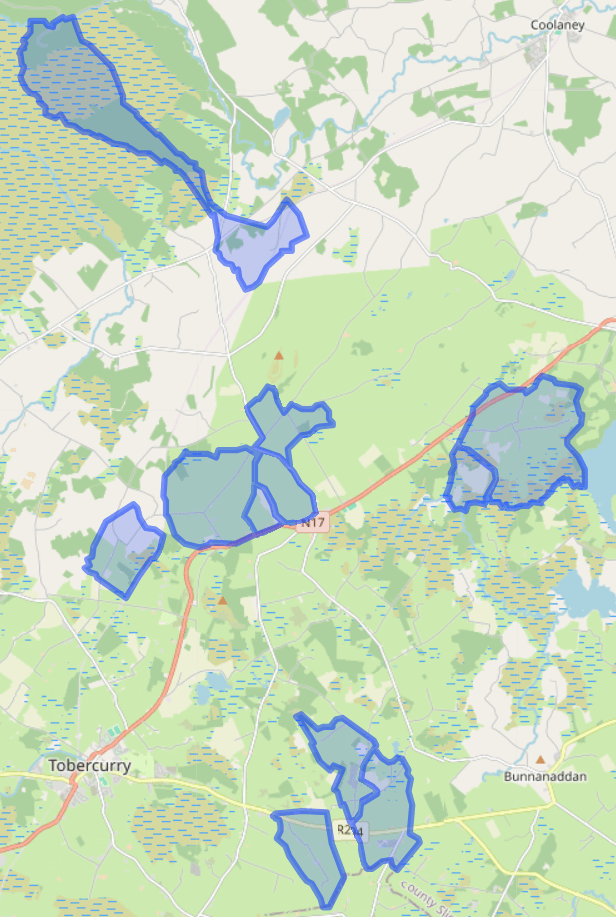
Figure 3. Townlands held by Paul Higgin in and around the parish of Achonry–Mullinabreena in 1641, mapped from the Down Survey Historical GIS. The pattern illustrates the extent of Higgins landownership within the historic territory of Leyny on the eve of the Cromwellian settlement. Source: Down Survey Historical GIS, Trinity College Dublin.
Although principally remembered as hereditary poets and scholars, the surviving evidence indicates that the Higginses also functioned as a substantial landed family deeply rooted within the local landscape. Their territorial concentration within the Achonry uplands may help explain the importance of the district within medieval Leyny itself. Situated between territories later associated with the O’Hara Buidhe and O’Hara Riabhach branches, the Achonry–Mullinabreena landscape appears to have occupied an important intermediary position linking different parts of the wider O’Hara lordship.
The influence of the family extended beyond Achonry parish itself. Terence O’Rorke recorded extensive Higgins possessions in Kilmacteige, while Down Survey records also place members of the family at Montiagh in neighbouring Curry parish and in parts of Cloonacool. These references suggest that the Ó hUiginn were not simply associated with a single locality, but formed part of a territorially significant Gaelic lineage whose influence extended across much of south Leyny.
An interesting feature of the later landscape is that several of the principal estate centres of the Achonry–Mullinabreena district later emerged within former Higgins lands. Chaffpool House developed at historical Dooghorne, while important later estate houses also arose at Clooncunny and Streamstown. Although this pattern may partly reflect the quality and strategic position of the land itself, it may also suggest that the Ó hUiginn family already occupied some of the more important settlement landscapes within the parish before the reorganisation of landownership in the seventeenth century.
The Cromwellian confiscations brought a dramatic end to the territorial prominence of the family in south Sligo. Like many Gaelic hereditary families associated with the old order, the Higginses lost much of their land during the settlement that followed the Confederate Wars. Over time the old Gaelic landscape of Dooghorne gave way to the landlord estates of the eighteenth and nineteenth centuries, centred upon houses such as Chaffpool House and other estate residences across the district.
Conclusion
The surviving evidence demonstrates that the Ó hUiginn family occupied a far more significant position within medieval south Sligo than that of hereditary poets alone. While renowned throughout Connacht for their contribution to the bardic tradition, they also formed an important landed Gaelic lineage rooted within the landscape of Achonry–Mullinabreena.
Historical references place the family headquarters at Dooghorne, now identifiable with the modern townland of Chaffpool. This identification is supported by placename evidence, early cartography and the continued survival of the name in the local landscape through features such as Dohern Hill. The connection is further strengthened by seventeenth-century records which show members of the Higgins family holding extensive lands across the Achonry uplands immediately before the Cromwellian confiscations.
The concentration of Higgins lands within Achonry–Mullinabreena, together with additional holdings in neighbouring districts such as Kilmacteige, Cloonacool and Curry, suggests that the family occupied an important position within the territorial structure of medieval Leyny. Although remembered primarily for their literary achievements, the Ó hUiginn were also significant landholders whose influence extended across much of south Sligo.
The Cromwellian settlement brought an end to the family’s territorial prominence, and over time the old Gaelic landscape of Dooghorne gave way to the landlord estates of the eighteenth and nineteenth centuries. Yet important traces of the family endured. Placenames, local traditions, historical records and census returns preserve evidence of a lineage that remained associated with the district long after its political power had disappeared.
The history of the Ó hUiginn family therefore represents more than the story of a distinguished bardic dynasty. It illustrates the close relationship between hereditary learning, landholding and local identity within Gaelic Ireland, while preserving an important chapter in the history of Achonry–Mullinabreena and the wider territory of Leyny.
Sources and References
Primary and Historical Sources
– Annals of the Four Masters.
– Down Survey Historical GIS, Trinity College Dublin.- Petty, William. Hiberniae Delineatio (1685).
– Inquisition held at Ballymote, 1610 (referenced in O’Rorke, History of Sligo).Books and Published Works
– O’Rorke, Terence. The History of Sligo, Town and County, Vol. II. Dublin: Duffy & Co., 1889.
– O’Reilly, Edward. Irish Writers.- Knott, Eleanor (ed.), works relating to Tadhg Dall Ó hUiginn and bardic poetry.
– McLysaght, Edward. A Short Study of the Transplanted Families in the Seventeenth Century. Dublin, 1935.
– Egan, Ursula; Byrne, Elizabeth; Sleeman, Mary; Ronan, Sheila; Murphy, Connie. Archaeological Inventory of County Sligo. Dublin: Stationery Office, 2005.
Books and Published Works
– O’Rorke, Terence. The History of Sligo, Town and County, Vol. II. Dublin: Duffy & Co., 1889.
– O’Reilly, Edward. Irish Writers.- Knott, Eleanor (ed.), works relating to Tadhg Dall Ó hUiginn and bardic poetry.
– McLysaght, Edward. A Short Study of the Transplanted Families in the Seventeenth Century. Dublin, 1935.
– Egan, Ursula; Byrne, Elizabeth; Sleeman, Mary; Ronan, Sheila; Murphy, Connie. Archaeological Inventory of County Sligo. Dublin: Stationery Office, 2005.
Online Resources
– Placenames Database of Ireland (Logainm.ie) — Chaffpool / Dooghorne:
https://www.logainm.ie/en/45682
– Down Survey Historical GIS:
Historical GIS
– Buildings of Ireland — Chaffpool House:
https://www.buildingsofireland.ie/buildings-search/building/32403802/chaffpool-house-chaffpool-sligo
– Landed Estates Database — Chaffpool:
https://landedestates.ie/property/17
– John Grenham — O’Higgins surname history:
– Wikipedia — Tadhg Dall Ó hUiginn:

 Mullinabreena
Leave a comment